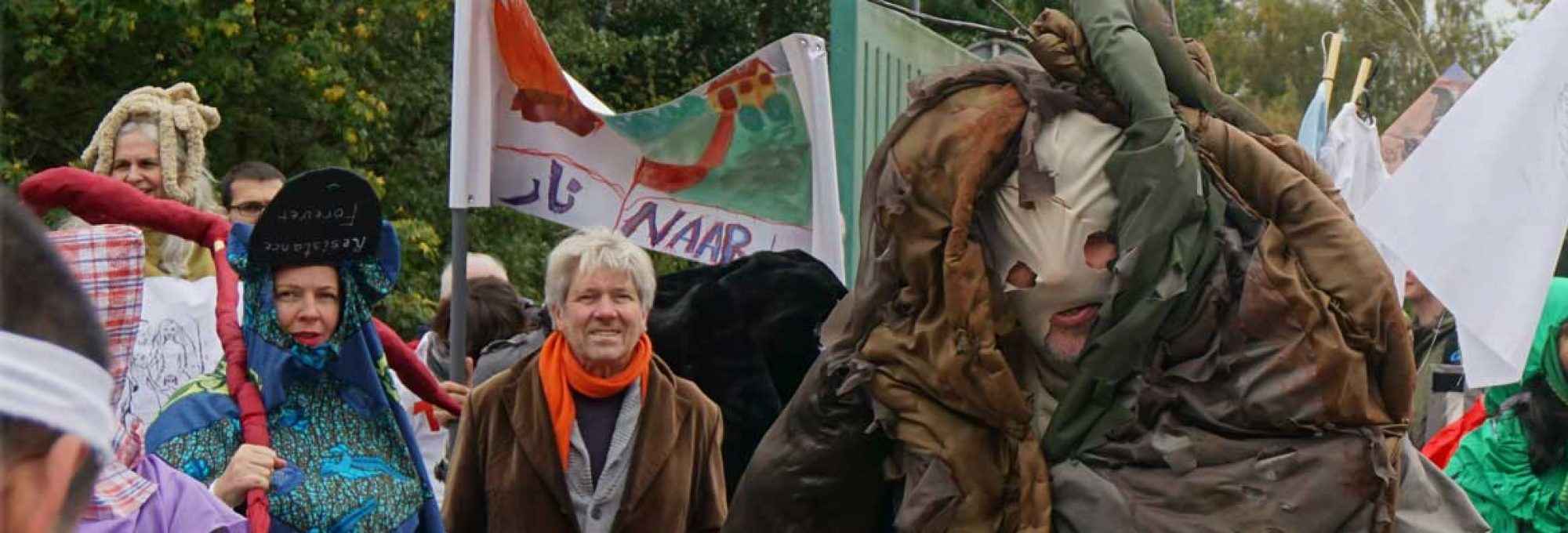
Fragility in Times of Fire brings together three aspects of the artist’s work: archival pieces
related to her work since the late 1990s,-early 2000s , the video SHIG and textile objects drawing
on her collaborations in Kyrgyzstan and new works that look to the future.
The scene that unfolds in Loods6 is from after a great fire. How that fire happened, who
caused it and why it was so destructive is left unsaid. In these times of war and genocide,
visitors are welcome to speculate but no simple answers are offered. Instead, what matters
here is that slowly forms of life are returning to the world. These forms have clearly suffered
from the inferno but they still survive. They were damaged not only by the fire but by the
exploitation and oppression that they can remember from before everything was burnt.
That’s why the protests and the evidence of that oppression are still so present. These
lifeforms are now looking for shelter. Everything is structured towards care and protection,
for themselves and for other forms that can also shelter within them. Some of these shelter-
beings begin to take on the scale of small monuments or Monusheterrrrs. They are hybrid
things conceived in trembling hope. They mark places where new life can begin and where
previous misfortunes can be remembered but not repeated.
After witnessing the toxic pollution in Kyrgyzstan, Gluklya returned to Amsterdam searching
for an artistic form capable of expressing both harm and resilience. The mushroom emerged
as such a figure: a symbol of sudden unpredictable appearing and disappearing, Mushrooms
remain mysterious organisms. They teach us about communication, survival, resistance,
endurance and celebrate ambivalence, collectivity and interconnectedness. According to the
artist, “picking mushrooms is a unique form of spending time not possessed by capitalist
markets. It is one of the few opportunities left for us in the ruins of capitalism. From my
childhood in Russian forests, picking mushrooms left a feeling of magic and miraculousness
that can never be rationalised or controlled fully”.
Learning from mushrooms also means defending a poetic approach to reality while
maintaining a clear political position. The right of art to remain ambivalent and poetic must
be defended alongside its commitment to solidarity and justice today. The exhibition is also
related to an actual fire that happened last year in the studio Gluklya shared with her mother.
The importance of showing her archive and older works could be found in this experience.
The connection between mushrooms and garment workers may initially appear indirect, yet
both are linked through the structures of survival and underlying solidarity. Garment workers
in Kyrgyzstan continue to live within the long aftermath of Russian imperial and Soviet
colonial histories, just as mushrooms survive in the face of poisoned environments and
depleted soils. Gluklya’s work in Kyrgyzstan with the sewing workers is present here as a
combined voice against injustice of both artist and workers. Beyond these specific relations,
Fragility in Times of Fire connects to birds, soil, plants and becomes a wider metaphor for
surviving the fire and what follows. Many of these are resilient organisms that are often
among the first to emerge after ecological devastation. Within these conditions, new forms of
collectivity and resistance continue to emerge. They borrow what they need from the past,
while imagining another kind of ground capable of sustaining collective life. There is sadness
but also reinvention and possibility for other lives to come.
The exhibition brings these elements together in a series of sculptures/assemblages, videos
and drawings that the artist has often made in collaboration with others. For a visitor, these
tangled webs of togetherness reveal themselves slowly but steadily as one follows the logic
and narrative of the works. There are large mushroom and smaller, wearable and
unwearable textile sculptures that float from the ceiling or rest on the floor. The bigger semi-
shelters/semi-monuments are called respectively Mushroom of Solidarity, Monushelterrr and
Resistance Dress (or The Dress that overgrows itself). They occupy the space of the former
Bagagehal and previously colonial warehouse of Loods6. Through them, one might imagine
what other lifeforms, wanted and unwanted, have passed these walls. Gluklya speaks about
“fluid and grounded energies” that flow through the space and which allow connections or
relations to be forged between objects, places and people.
The forms of many of the sculptures recall the garments and textiles made in Bishkek, the
capital of Kyrgyzstan where Gluklya has worked regularly. Once used to protect and adorn
human bodies, they now offer care and resistance. To picture their conditions and respond
to their needs, Glyklya has created an imaginary union: SHIG (Union of Sewing Workers and
Artists). The members seek to resist alienation and build a new life for themselves through
rituals, learning and the hopes and dreams of protest. The textiles that the SHIG members
manufacture are present throughout the exhibition along with the new textile sculptures
derived from mushroom -mycelium context. Together, they create a community of resilience
that can shape another way of living through art and activism.
Gluklya in collaboration with Charles Esche, Amsterdam 2026