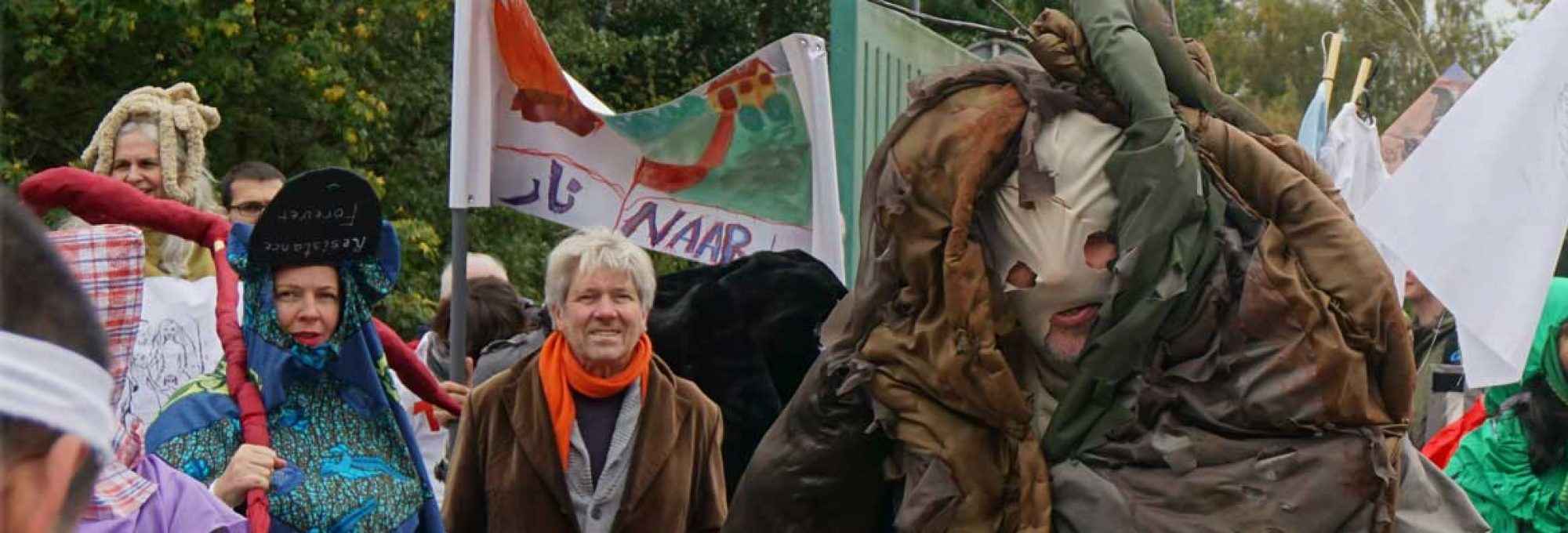
Fragility in times of Fire

Fragility in Times of Fire brings together three aspects of the artist’s work: archival pieces
related to her work since the late 1990s,-early 2000s , the video SHIG and textile objects drawing
on her collaborations in Kyrgyzstan and new works that look to the future.

The scene that unfolds in Loods6 is from after a great fire. How that fire happened, who
caused it and why it was so destructive is left unsaid. In these times of war and genocide,
visitors are welcome to speculate but no simple answers are offered. Instead, what matters
here is that slowly forms of life are returning to the world. These forms have clearly suffered
from the inferno but they still survive. They were damaged not only by the fire but by the
exploitation and oppression that they can remember from before everything was burnt.
That’s why the protests and the evidence of that oppression are still so present. These
lifeforms are now looking for shelter. Everything is structured towards care and protection,
for themselves and for other forms that can also shelter within them. Some of these shelter-
beings begin to take on the scale of small monuments or Monusheterrrrs. They are hybrid
things conceived in trembling hope. They mark places where new life can begin and where
previous misfortunes can be remembered but not repeated. 

After witnessing the toxic pollution in Kyrgyzstan, Gluklya returned to Amsterdam searching
for an artistic form capable of expressing both harm and resilience. The mushroom emerged
as such a figure: a symbol of sudden unpredictable appearing and disappearing, Mushrooms
remain mysterious organisms. They teach us about communication, survival, resistance,
endurance and celebrate ambivalence, collectivity and interconnectedness. According to the
artist, “picking mushrooms is a unique form of spending time not possessed by capitalist
markets. It is one of the few opportunities left for us in the ruins of capitalism. From my
childhood in Russian forests, picking mushrooms left a feeling of magic and miraculousness
that can never be rationalised or controlled fully”
.

Learning from mushrooms also means defending a poetic approach to reality while
maintaining a clear political position. The right of art to remain ambivalent and poetic must
be defended alongside its commitment to solidarity and justice today. The exhibition is also
related to an actual fire that happened last year in the studio Gluklya shared with her mother.
The importance of showing her archive and older works could be found in this experience.

The connection between mushrooms and garment workers may initially appear indirect, yet
both are linked through the structures of survival and underlying solidarity. Garment workers
in Kyrgyzstan continue to live within the long aftermath of Russian imperial and Soviet
colonial histories, just as mushrooms survive in the face of poisoned environments and
depleted soils. Gluklya’s work in Kyrgyzstan with the sewing workers is present here as a
combined voice against injustice of both artist and workers. Beyond these specific relations,
Fragility in Times of Fire connects to birds, soil, plants and becomes a wider metaphor for
surviving the fire and what follows. Many of these are resilient organisms that are often
among the first to emerge after ecological devastation. Within these conditions, new forms of
collectivity and resistance continue to emerge. They borrow what they need from the past,
while imagining another kind of ground capable of sustaining collective life. There is sadness
but also reinvention and possibility for other lives to come.

The exhibition brings these elements together in a series of sculptures/assemblages, videos
and drawings that the artist has often made in collaboration with others.  For a visitor, these
tangled webs of togetherness reveal themselves slowly but steadily as one follows the logic
and narrative of the works. There are large mushroom and smaller, wearable and
unwearable textile sculptures that float from the ceiling or rest on the floor. The bigger semi-
shelters/semi-monuments are called respectively Mushroom of Solidarity, Monushelterrr and
Resistance Dress (or The Dress that overgrows itself). They occupy the space of the former
Bagagehal and previously colonial warehouse of Loods6. Through them, one might imagine
what other lifeforms, wanted and unwanted, have passed these walls. Gluklya speaks about
“fluid and grounded energies” that flow through the space and which allow connections or
relations to be forged between objects, places and people.

The forms of many of the sculptures recall the garments and textiles made in Bishkek, the
capital of Kyrgyzstan where Gluklya has worked regularly. Once used to protect and adorn
human bodies, they now offer care and resistance. To picture their conditions and respond
to their needs, Glyklya has created an imaginary union: SHIG (Union of Sewing Workers and
Artists). The members seek to resist alienation and build a new life for themselves through
rituals, learning and the hopes and dreams of protest. The textiles that the SHIG members
manufacture are present throughout the exhibition along with the new textile sculptures
derived from mushroom -mycelium context. Together, they create a community of resilience
that can shape another way of living through art and activism.

Gluklya in collaboration with Charles Esche, Amsterdam 2026
Gulmira Fairytales

Video screening at the 25 universally of Citadellartepistoletto,Biella,Italy, 21-25 September 2024

Society of the Spontaneous Confessions

Part 1 Presentation of the artistic research Chachacha op het Marinetrein en verder

in collaboration with Robert Stijn

Bau ,Amsterdam

https://www.bau.amsterdam/nl/nieuws

Utopian Unemployment Union /London 23

Drawing in Social Space Project 2

I was invited to be the Project Artist for ‘Drawing in Social Space Project 2’, a knowledge exchange project with Camberwell College of Arts Fine Art and Drawing Room in London exploring drawing beyond the gallery walls.  

Always feel more friend than a teacher and this workshop fully served this intention, which was exciting!

The outcome of the process was a performative drawing session in St. Michaels Church with the art students and local mothers from PACT, which is a sort of a caring club for local migrant community who are gathering regularly at the church to support their wellbeing. It was the most organic place for the workshop which was planned with and supported by curators Renee Odjidja (Camberwell) and Misty Ingham (Drawing Room).

I proposed to extend the idea of drawing to the scale of the body and came up with the preposition for the original design of the “VESTS WITH ATTACHED PENCILS ” allowing to draw and dance at the same time. The workshop starts with short breathing and movement exercises, which Renee kindly shared with the group, and then we talk using the spiral conversation technique (round talk with the care control over the time) about well-being, and what it means for each of the participants.

I proposed to think about Wellbeing as something which embraced also the dark side of each of us and asked Misty to read part of my proposal for this encounter which was on the abstract notion of wellbeing, spontaneousness and movement. 

“We are all migrants and defending the idea of the rights of migration, we are interested in moving matters. A combination of moving and drawing might bring us to the de conventionalisation of the idea of drawing as just seating in one place and focusing on the particular subject in the classical way.

When we are lost the time is our friend.”

After that, with the help of Irish music, everybody starts to draw on the carefully prepared paper over the windows. Wonderfully, Misty took the initiative to announce the start of this process.

Migrant mothers came with kids and there was a special place for them that was organized so that they can draw as well.

After the drawing session was accomplished and the mothers left us, we talked with students and staff from PACT about the process.

Club of Unpredictable Drawing

Performative encounter with PACT + Students

Spontaneous drawing session is dedicated to Well Being.

Wellbeing is an abstract notion and because of the nature of its abstract universality it is open for our interpretations. I propose to think about the wellbeing through the lenses of imagination and unpredictability. Unpredictability can be resolved through the spontaneousness, which in turn can be understood as a result of the freedom to do the action which is coinciding with our entire feeling of truth, which in other turn can be understood as a creation of the entire free space which might lead to the act of the creativity.

The other notion I propose to explore during our encounter is the movement. We are all migrants and defending the idea of the rights of migration we are interested in moving matters. A combination of moving and drawing might bring us to the de-conventionalization of the idea of a drawing as just sitting in one place and focusing on the particularity.

When we are lost the time is our friend.

Practical realization :

The group of 4 students, 2 observers ( Misty and Renee ), several parents ( some of them might be with kids ) and artist Gluklya are gathering in the circle . Gluklya invite everybody to share a thought about well-being. What it might mean for each of us. Gluklya also explain the rule of this session: everybody has to speak not more than 3 min. We will do one or two rounds of speaking like this. One of the Observers is controlling the time and after every 3 min is saying: Clock!

After that, when all the ideas about the well-being is collected, the wests with the drawing tools will be introduced to people and everybody is welcomed to dress them on.

Gluklya will explain the rules: Everybody are invited to move freely in the room, trying to mark the surface of paper by the attached drawing tool.

We might do two sessions: one with closed eyes and other with open eyes

Students are invited to listen carefully one by one each of the parents and write down or record the impressions of different outcome: with open eyes and close eyes.

After the session Gluklya and students and all participants are connecting stains made by unpredictable drawing session together by the red color.

Session finished.

The graphic outcomes might be used by Pact in their future campaigns.

Last News

Sanatorium for Seamstresses

Chuikov Gallery and Library of Rescued Books Bishkek,Kyrgyzstan6-19 OctoberINTERPRETING THE HISTORY OF POLLUTIONArt Prospect & TRASH-5

Field wifes

Museum Rijswijk/NL Installation of two parts IMAGES OF POWER/Textile Bienalle 26 June -12 November 2023

Against the War

Museum Helmond /NL RESILIENT REBELS 14 October -24 March 2024

Drawing Room, ( UAL) London

September 2023 The show is the result of the project: Drawing in social space, collaboration with UAL students and migrants from PACT, following the method: Utopian Unemployment Union

Zimmerli Art Museum

"The Body Implied" 16 February - 30 July 2024 https://zimmerli.rutgers.edu/ Curator: Stephanie Dvareckas

Solo Show: To those who have no time to play

EXHIBITION OPENING: 13 October, 19:00 ARTIST: Gluklya (Natalia Pershina-Yakimanskaya) SUPPORTED BY: Ministerie van Onderwijs, Cultuur en Wetenschap; Gemeente Amsterdam; AFK; Stichting DOEN; Van Abbemuseum IN COLLABORATION WITH: Moawya Alkhadra BiSCA (Saadat Aitalieva) Shepherd Camara Roger Cremers Liah Frank Natalia Grezina Marianne Koeman Vladimir Rannev Benjamin Roth Gulmira Tursunbaeva Anna Bitkina Shaiymkan Chylgobaeva Kunduz Asanakunova Anisa Ibrayeva Nurlan Alymseitov Dinara Akylova Rahat Bolotbek Kyzy Zayna Ayazbekova Open Line Foundation CURATOR: Charles Esche Framer Framed presents To those who have no time to play, the largest solo exhibition for the Amsterdam-based artist Gluklya (Natalia Pershina-Yakimanskaya), curated by Charles Esche. In keeping with her previous work, the exhibition involves many collaborators from Kyrgyz textile workers and recent migrants to the Netherlands to musicians and writers. The exhibition is structured around four elements, each with its own unique architecture. These are two yurts, a dome, and a stage on which there will be occasional live performances. The works take us from Amsterdam to Bishkek, and via St. Petersburg back to Amsterdam again. Although conditions in Bishkek or St. Petersburg might seem far from Dutch society, bringing these different social and emotional geographies together through art emphasises connections between them. It is impossible to ignore the many disasters looming on the horizon: the climate crisis, extreme social inequality, the war in Ukraine and the harsh working lives of people supplying cheap goods to Western high streets. Gluklya relates it all in a surreal landscape, where humour appears unexpectedly. She takes us on an associative journey through global abuses, whether they be forced labour and migration, economic exploitation or abuse of power. CONTACT: www.framerframed.nl info@framerframed.nl ADDRESS: Oranje-Vrijstaatkade 71, 1093 KS Amsterdam OPENING TIMES: Tue – Sun (12:00 - 18:00) Free Entree

The book “Two Diaries”

This book emerged as a collaboration with Kurdish activist Murad Zorava, who started to write during this project and I hope he might continue.

In 2017, I was renting a studio in one of the two towers of Bijlmerbajes, a former prison in Amsterdam-Zuid-Oost. The second tower was then used by the government as an Asylum-Seekers-Center (AZC). My plan was to attempt a collaboration with the refugees staying there at the time, among whom was Murad.

During my project in Bijlmerbajes, I was confronted with eye-opening questions: What does equality mean, when it is equality between a refugee and an artist, between – so to speak –trained artist and the person who did not study art at all? Can we imagine rethinking and abandoning the idea of enlightenment? How to deal with the notion of Care without falling into patronization, but soberly staying within the frame of Radical Care? 

At the start of my research, I visited AZC meetings. These were some of the regular lessons provided to the refugees to teach them about the social structure of the Netherlands and what they could expect here. Nothing was said during those meetings about culture and art, let alone contemporary art. This was surprising to me. It felt as if these people were held not equal to us, westerners, as many westerners believe they cannot survive without a breath of cultural or artistic air. Another thing that struck me was the fact of placing people in the environment of a prison: bars on windows, no locks from inside the rooms, no actual privacy, and unpleasant communal places.

Being haunted by this image of Murad in the cell of the former prison, I started to think about what exactly I could do in this situation. During one of the workshops, I proposed participants write a diary, and Murad accepted this idea. I am very happy to hope that the project had a practical outcome in reality. Murad believes that work with the publishing of his Diary helped him to settle down in Amsterdam.

The book can be  purchased here https://www.buchhandlung-walther-koenig.de/koenig2/index.php?mode=details&showcase=1&art=1638030

New Exhibition: To those who have no time to play

Framer Framed presents To those who have no time to play, the largest solo exhibition by the Amsterdam-based artist Gluklya (Natalia Pershina-Yakimanskaya), curated by Charles Esche.
In keeping with her previous work, the exhibition involves many collaborators from Kyrgyz textile
workers and recent migrants to the Netherlands to musicians and writers.
The exhibition is structured around four elements, each with its own unique architecture. These are two
yurts, a dome, and a stage on which there will be occasional live performances. The works take us from Amsterdam to Bishkek, and via St. Petersburg back to Amsterdam again.
We are pleased to
invite you to the exhibition To those who have no time to play for a review. During the opening, curator Charles Esche, artist Gluklya and select collaborators will be present. Reserve a spot by emailing press@framerframed.nl.

Location
Framer Framed
Oranje-Vrijstaatkade 71
1093 KS, Amsterdam

Opening
13 October 2022, 19:00-21:00

Dates
14 October 2022 – 22 January 2023

Opening hours
Tuesday – Sunday, 12:00-18:00
Free entree

To see the full info go to Detailed Info

Documenta 15

Documenta 15 is great this year! Really really ..

It is trespassing all the conventional norms in terms of how the perception of the public should be structured: focus on the values as sharing and caring is prevalent and obviously etic is dominating on esthetic in a good way. 

It does not mean that there is no good and beautiful works. A lot of them! 

The enormous number of artists invited, 1500! Artists are invited other artists, not any single “famous “in terms of selling’s artists involved

And on top of that, the scandal around the topic of the trauma of WWII, provoked a great solidarity among artists, one more time proving that the values of the socialism are still alive and strong. This generosity triggered us to contribute with a performative spontaneous gesture of taking art works by People’s Justice by Taring Padi down from the exhibition by adding to the display this example of the Utopian Dress, regarding a very recent R/U War, which brought an immense global impact. 

Inspired by Natalie Pershina | Copyright © 2018