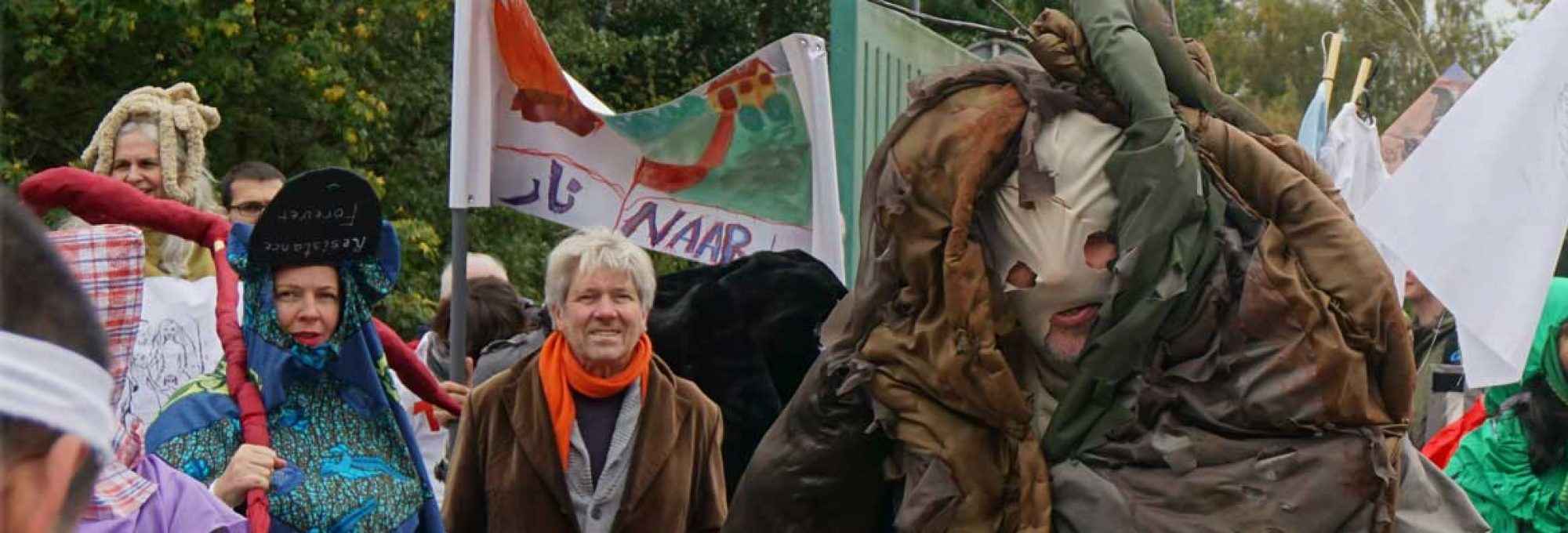
Natalia Pershina-Yakimanskaya (artist name Gluklya) lives and works in Amsterdam.
Gluklya is considered as one of the pioneers of feminist performance after the collapse of the Soviet Union in the 1990s. The performative approach still forms the basis of her practice today, though her works now encompasses a wide range of media and working methodologies including installations, textile sculptures, texts, videos, watercolors, staged performances, workshops with migrants and newcomers, performances-rituals, performative participation in political demonstrations, visual poetry and conceptual clothing.
Gluklya’s oeuvre speaks of indignation and hope. With her projects she proposes playful ways to resist injustice and find empowerment. At the 56th Venice Biennale Gluklya presented forty-three ‘Clothes for Demonstration Against False Election Of Vladimir Putin (2011 – 2015)’ in the exhibition ‘All the World’s Futures’, curated by Okwui Enwezor. The installation documents hopes, dreams and traumas of people who went into the streets in 2011-12 to demonstrate against the oppressive government. From 2019 to 2022 in the context of her research Two natures of Colonialism: Russian and European’ /Lives and work of oppressed women , Gluklya visited Indonesia and Kyrgyzstan and those experiences continue to have a strong influence on her work.
Her appearance as an artist is rooted in perestroika times, when the Soviet Union tried first to reform itself and finally collapsed in 1991. The following years of wild capitalism were corrupt and ultimately destructive, but they did harbour the fruitful delusion for artists that suddenly everything was possible. This delusion of liberty allowed for perspectives to open and for a new artistic and poetic language to shape utopian fantasies of real change.
Dialogues with other artists were equally significant and the subject of clothes became a core issue for her with the development of the Factory of Found Clothes (FFC)* project in Saint Petersburg together with her fellow artist Tsaplya. The FFC developed a philosophy of clothes as artistic means, understanding the composition of human, body, dress, fabric as a way of building relations between human and non-human representatives.
The conceptual clothing that emerged from the FFC followed two main directions: one as an artistically personified object, or a sort of Thing -in -Itself that stood for possible relations and another as a tool to actually create relationships with communities outside and inside the art world in a way that might be comparable to ‘meals’ used in other participatory artistic projects.
From 2012 on, Gluklya has been working on the project The Utopian Unemployment Union (UUU) uniting art, social science, and progressive pedagogy. The project gives people from all kinds of social backgrounds the opportunity to develop their own statements about themselves and their position in the world through using the artist’s method of embracing human fragility. This concept artist has developed over many years and is perhaps best described by Marina Vischmidt: Factory of Found clothes (FFC) developed the logic of ‘fragility’ as subjectivity antagonistic to that which is the state of things – be that the repressive social and political climate of Russia or the reflexive futilities of international art scenes. With this negative-utopian, rather than affirmative-ironic version of the subject of participatory aesthetics, something akin to Wittgenstein’s “the subject does not belong to the world, it is a border of the world”, FFC’s-approach puts an interesting swerve on the ‘relational turn’ as enunciated in Western art discourse. *
The UUU method is always in collaboration and often involves creating temporary collectives that lead to collective writing and making. Gluklya analyses the conflict between the inner world of a person and the political system, creating scripts and co-written scripts for her performances and Installations based on characters derived from the real stories. Before creating a work, she interviews people and uses the recordings as the basis for the fictional narrative or word-collages. This methodology led to the creation of the Matras Platform group and the script for the performance called Antigone Update.
Gluklya’s most recent solo exhibition was The Shadow of Care at AKINCI. This solo exhibition unfolded from her long-term research in the Kyrgyz Republic since 2021. The exhibition examines care not as an unquestioned moral good, but as a contradictory force — one capable of protection, discipline, suffocation and control. Gluklya’s engagement with the notion of care emerged through her encounters with women working in the textile and fashion industry in Bishkek, a major center for garment production, primarily for export to the Russian market. Listening to the stories of seamstresses, she began to trace how care operates within systems of production: as concern, dependency, obligation and exhaustion.
Preceding this exhibition was To Those Who Have No Time to Play at Framer Framed in Amsterdam from Oct. 2022 to Jan. 2023. This exhibition was the result of her ongoing research in Kyrgyzstan and different collaborations with migrants in Amsterdam. The constellation of installations in Framer Framed offered a journey in which the visitor could assume different roles: a reader of The Two Diaries, a witness of a political demonstration in St. Petersburg, a listener of a night-time story, and a spectator of a techno-performance of Antigone — the classical text adapted by the ‘Mattress Platform’ — a collective of refugees and homeless people. Convened by Gluklya, they had rewritten Sophocles’ piece to enable Antigone to take part in a collective protest, therefore empowering her subjective desires and resisting patriarchal injustice.
The curator of the exhibition Charles Escher wrote, “What Gluklya’s work shows is not only empathy for that difficult truth, but how art offers a way to process the trials of global contemporary life and imagine a future that accommodates reduced material security without despair.”
The research in Kyrgyzstan is particularly important at this time of renewed Russian imperialism as it directly addresses the historic and ongoing colonial exploitation by
Russia of indigenous societies in Central Asia. Gluklya visited Kyrgyzstan again in 2023 to take part in Trash-5 festival in Bishkek, allowing her to continue her research on the life and work of garment workers. She applied her method of the Utopian Unemployment Union and invited the garment workers to speak about their struggles. As a result of the research, Gluklya developed the Utopian Union of Bishkek — a strategy to engage the sewing workers of the city in a collaboration with artists under the working title Sanatorium for Seamstresses, which was on view in The Shadow of Care.
Gluklya co-founded the artist collective The Factory of Found Clothes (FFC) in 1995 using conceptualized clothes as a tool to build a connection between art and everyday life and Chto Delat group, of which she has been a member since 2003.
Work by Gluklya has been exhibited in numerous group shows as well as solo shows, such as : To those who have no time to play ,Framer Framed, Amsterdam,2022-23 NL, curated by Charles Esche; ‘Clothes for Demonstration Against False Election Of Vladimir Putin ,Fashion Show ,GLUСKSMAN,2022,IR They are among Us,DENANZIATION,ACC GalerieWeimar,2022 DE,Propaganda Flowers, Botanical Revolution ,Nest Den-Haag (2021-22), Monument to Modern Slavery , disturbance :witch ,ZAK Center for Contemporary Art, Berlin, DE (2020) .Care about the Sun, Cristal Clear ,Pera museum, Istanbul (2021);Fotogalleriet, Oslo, NO (2019); Circus Truth BOZAR, Brussels, BE (2019); Intercultural Museum Oslo NO (2019); Carnival of the Oppressed Feelings joining KARNEVALET, Oslo, NO (2019); Extra City, Antwerp, BE (2019); Positions 4, curated by Charles Esche, Van Abbemuseum Eindhoven, NL (2018-19); Manifesta, Palermo, IT (2018); Garage Moskow, RU (2018); Pitzer College Art Galleries, Claremont, CA, USA (2018); The Return Of Memory, Manchester’s Home, Manchester, UK (2017); dis/order, art and activism in Russia since 2000, Ludwig Forum für Internationale Kunst, Aachen, DE (2017); A Romance with Revolution, ACC Galerie Weimar and Pushkinskaya-10, St. Petersburg,DE/RU (2017); Disturbance, Kunsthalle der Sparkasse, Leipzig, DE (2017); Hero Mother, Berlin, DE (2016); Debates on Division,Creative Time Summit ,Lincoln Theater ,Washington DC,2016 Universal Hospitality, Vienna, AU (2016); Feminism is Politics, Pratt Institute, New York, USA (2016); Debates on Division: When the Private Becomes Public, Manifesta 10, Public Program, St. Petersburg, RU (2014); Dump Dreams, Shedhalle Zurich, CH (2013); Utopian Unions, MMOMA, Moscow, RU (2013); Reflecting Fashion, MUMOK Vienna, AU (2013), Wings of Migrants, AKINCI, Amsterdam, NL (2012).
Gluklya’s work is part of many museum and private collections, including the collection of Van Abbemuseum Eindhoven, NL;Muzeum Sztuki w Łodzi,Gemeentemuseum Arnhem, NL; Victoria and Albert Museum London UK, Moscow House of Photography, RU; Oslo Contemporary Art Museum, NO; Zimmerly Collection, USA; Mark Suchek, Ljubljana, SL; Archive of the Contemporary Conflict, London, UK; ; MMOMA, Moscow, RU; Centro per l’Arte Contemporanea Luigi Pecci, Prato, IT; Museum Reina Sophia, Madrid, ES; Museum of Contemporary Art, Belgrade, RS; The Library of Museum of Modern Art New York, USA., Centraal Museum Utrecht NL, Sanders Collection.
Gluklya continues to work on establishing dialogue with newcomers and finding ways to help express the condition of migration and movement, the psychological effects of integration and inclusion policies and the possibility of collective action and creative work from those perceived to be on the margins by much of mainstream society. In 2014, Gluklya was the recipient of a visual arts fellowship awarded by The Joseph Brodsky Memorial Fund. The fellowship allowed her to spend three months in Venice and Rome.
In 2017 she was nominated for the Anni and Heinrich Sussman Artist Award.
In 2025, Gluklya was awarded a UK Research and Innovation Network Plus Art Fellowship as part of the Shifting Global Polarities: Russia, China and Eurasia in Transition.